
Source: B. Stitmannaithum, Q. Hussain, C. Chintanapakdee, M. Kaewmoracharoen, P. Pheinsusom, R. Kumpoopong, P. Homcheun, T. Jirawattanasomkul. Use of prestressed rubber strips for cracking prevention of reinforced concrete bridge piers due to chloride attack. Case Studies in Construction Materials 23 (2025), e05270. doi:10.1016/j.cscm.2025.e05270 (open access).
Chulalongkorn University, Thailand Department of Highways
Chloride-induced corrosion is a persistent durability problem of coastal and marine bridges. Conventional repairs (removing damaged concrete, replacing corroded steel, thicker cover) are expensive and do not stop further chloride ingress. The study tested a simpler measure: compressive prestress applied to the concrete cover with rubber strips cut from standard bridge bearing pads. The compression slows down chloride penetration and, on piers that are already corroded, restores part of the lost strength and ductility.
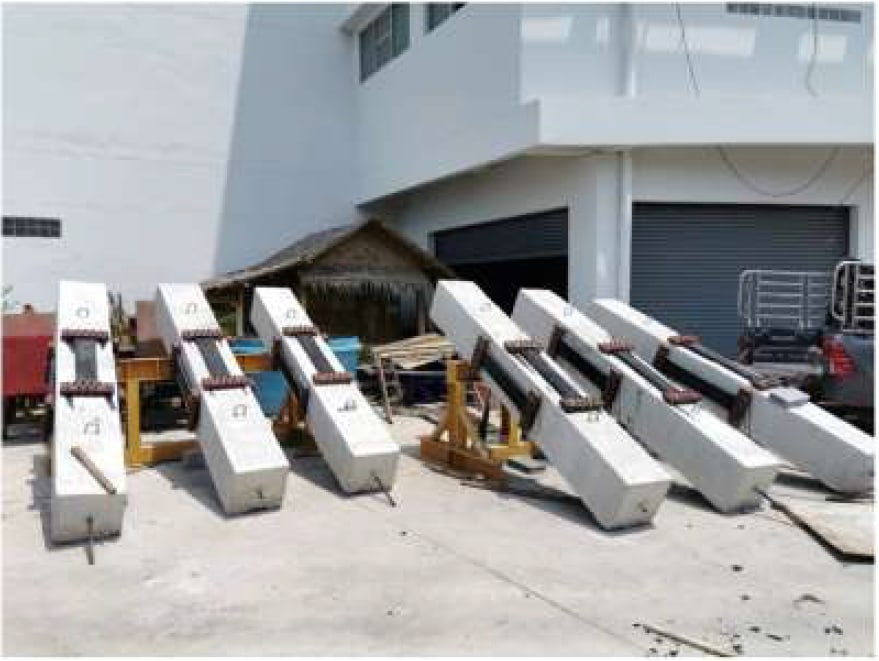
Approach
Strips of natural rubber (hardness 50, the grade used for bridge bearing pads of the Department of Highways), 20 × 4 × 50 cm, were stretched with a hydraulic jack and a clamping frame, anchored to the column with epoxy-set studs and released, which transferred compression into the concrete. Columns were exposed for 60 days either in the laboratory (immersion in a 14 % chloride solution) or in the field, under the Mae Klong River Bridge in Samut Songkhram Province in brackish tidal water. To simulate corrosion damage, the longitudinal reinforcement of a second set of columns was machined down to 75 %, 50 % and 25 % of its cross-section, and the columns were load-tested with and without the strips.
The columns were modelled in ATENA in 2D and 3D with the SBETA concrete model, smeared and embedded reinforcement, and smeared rotating and fixed crack models. Bond degradation in the corroded zone was modelled directly.
Results
- At the maximum prestress (about 7.2 t), the chloride diffusion coefficient decreased by about 24 %, from 4.85 to 4.96 × 10⁻⁷ cm²/s to 3.67 to 3.79 × 10⁻⁷ cm²/s, with the same trend in the laboratory and in the field.
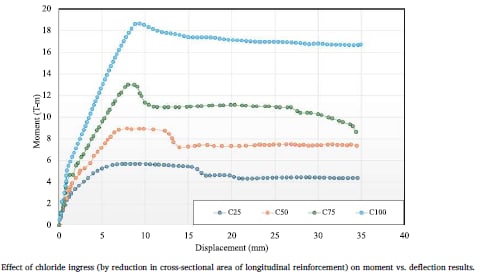
- On the columns with 75 % reinforcement loss, the yield moment increased by 45 %, from 4.0 to 5.8 t·m, and the deflection capacity also increased.
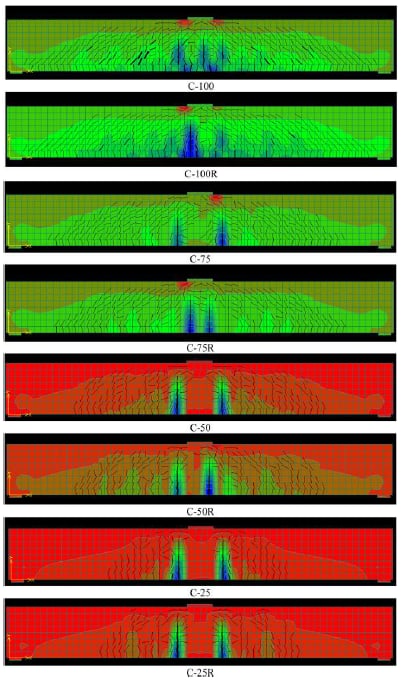
- The ATENA model showed the same trend: an increase of moment capacity of 12.4 % at 75 % reinforcement loss, 5.8 % at 50 % and 2.7 % at 25 %, and a negligible effect on undamaged sections. The measure is most effective where the damage is largest.
- The crack patterns from ATENA matched the tests; the strengthened columns had fewer and better distributed cracks.
The retrofit uses material and equipment that bridge agencies already have (bearing-pad rubber, a hydraulic jack, drilled anchors) and does not require removal of sound concrete.
This page summarises independent, peer-reviewed research by Chulalongkorn University and the Thailand Department of Highways. Červenka Consulting was not involved in the study; it is presented as an example of ATENA used in research and practice.