
Source: P. Pheinsusom, C. Ngamkhanong, P. Latcharote, Q. Hussain, C. Chintanapakdee, T. Jirawattanasomkul, R. Kumpoopong, T. Ueda. Fragility-based seismic evaluation and GFRP retrofitting of short-span bridge piers in Thailand's seismic zones. Results in Engineering 32 (2026), 112023. doi:10.1016/j.rineng.2026.112023 (open access).
Chulalongkorn University, Mahidol University, Thailand Department of Highways, Shenzhen University
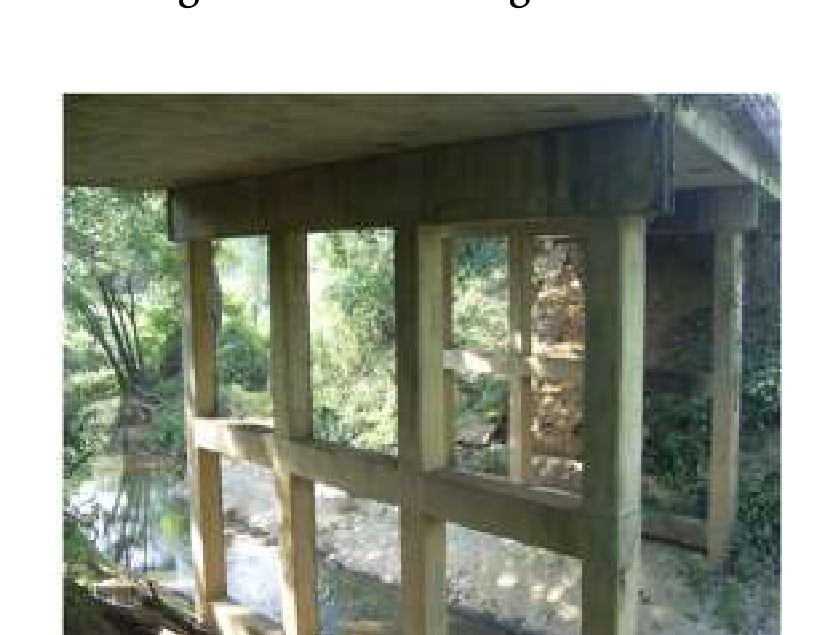
Short-span highway bridges in Thailand (spans of 5 to 10 m) were designed without explicit seismic detailing. Most of their substructures are pile-bent piers with widely spaced transverse reinforcement, limited confinement and short lap splices near the column base. Active faults in Phrae Province in northern Thailand are now considered capable of magnitude 6 to 7 earthquakes. The study tested how vulnerable these piers are, developed a retrofit with locally made glass fibre reinforced polymer (GFRP) and assessed the bridges of a whole highway district.
Tests and ATENA model
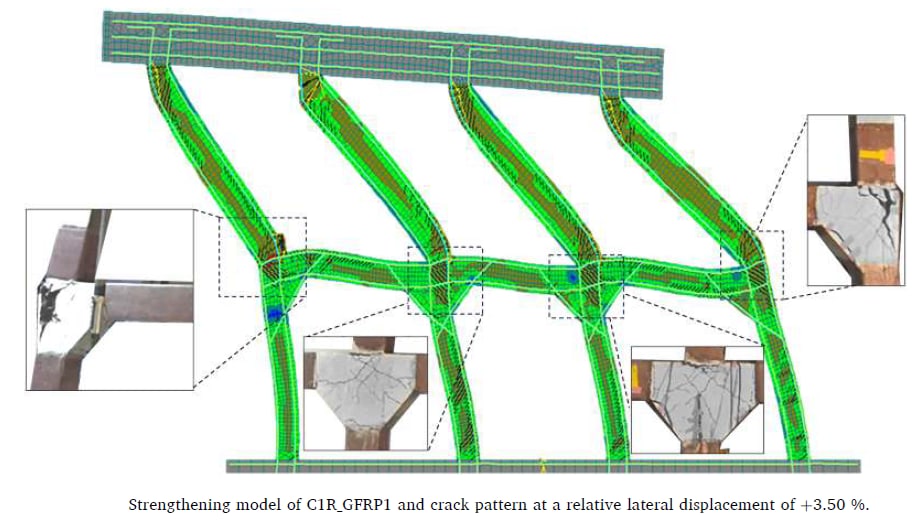
Pile-bent pier specimens at 1:2 scale, with the geometry, reinforcement and deficiencies of the Department of Highways designs, were tested under quasi-static cyclic lateral loading (FEMA 461). Two GFRP schemes were compared: wrapping of the columns and the bracing beam, and the same with continuous confinement through the beam-column joints. Specimens were tested both repaired after damage and strengthened before loading. The GFRP was made of unidirectional E-glass fibres and a bio-based epoxy resin.
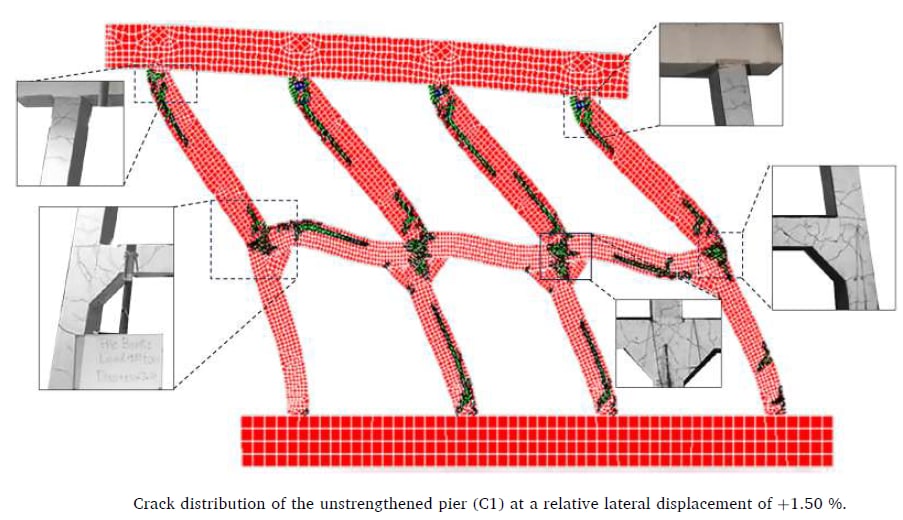
The 2D nonlinear model in ATENA used the SBETA-based concrete model with smeared rotating and fixed crack models; the GFRP was represented as linear elastic smeared reinforcement acting in tension only. The model was validated against the hysteresis loops, the backbone curves and the observed crack patterns. It reproduced both the diagonal shear cracking of the unstrengthened piers and the distributed flexural cracking of the wrapped piers.
Regional fragility analysis
With the capacity parameters from the validated model (yield force, ultimate capacity, ductility), nonlinear pushover analyses in SAP2000 were run for 24 pier configurations in the three seismic zones of the Phrae Highway District. Monte Carlo sampling of material properties (25 realisations per configuration) gave fragility curves for repairable damage and for collapse at return periods of 475 and 2,500 years.
Results
- Piers repaired and strengthened with GFRP reached a 22 to 24 % higher peak lateral load (104.0 to 129.0 kN and 123.7 to 151.0 kN).
- Ductility of the repaired and strengthened specimens increased by up to 34.6 %. Piers strengthened before loading reached a ductility of up to 6.78, compared with 2.08 to 2.35 for the unstrengthened piers.
- Piers strengthened before loading reached 136.0 to 145.0 kN, 17.2 to 30.8 % more than the unstrengthened piers.
- Unretrofitted piers in the high-hazard zones reached a collapse probability of 40 % for the 475-year earthquake and up to 100 % for the 2,500-year earthquake. Taller piers with bracing beams and longer spans were the most vulnerable.
- With four layers of GFRP on the critical regions, no configuration collapsed under the 2,500-year demand.
The combination of tests, a validated nonlinear model and a regional assessment gives a ranked list of pier types, spans and zones to retrofit first. The surveyed district alone has 145 short-span bridges.
Software
- ATENA: nonlinear model of the tested piers, validated on crack patterns and hysteresis
- SAP2000: pushover analyses for the regional fragility assessment
This page summarises independent, peer-reviewed research by Chulalongkorn University, Mahidol University, the Thailand Department of Highways and Shenzhen University. Červenka Consulting was not involved in the study; it is presented as an example of ATENA used in research and practice.