
Source: N. Boonintra, K. Tapsuphonkul, P. Pheinsusom, C. Ngamkhanong, T. Jirawattanasomkul, W. Pansuk, Y. Sato. Reliability assessment of RC bridge piers under chloride-induced deterioration using nonlinear finite element analysis. Case Studies in Construction Materials 23 (2025), e05610. doi:10.1016/j.cscm.2025.e05610 (open access).
Waseda University, Chulalongkorn University, Thailand Department of Highways
In coastal reinforced concrete bridges, chlorides penetrate the concrete cover, break down the passive layer of the reinforcement and start corrosion that reduces both the steel cross-section and the safety margin. The study combined nonlinear finite element analysis with probabilistic reliability analysis on an in-service structure: Pier No. 5 of the Chanthaburi River Bridge in eastern Thailand, exposed to tidal splash and airborne chlorides from the Gulf of Thailand and already showing corrosion damage in field surveys.
Approach
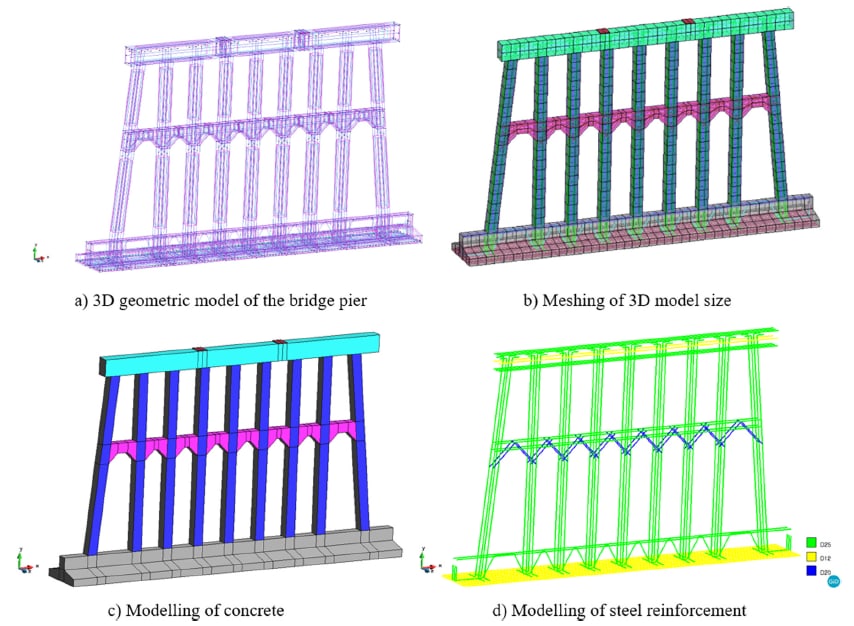
The geometry of the pier (cap beam, bracing, pier shaft, footing and reinforcement) was modelled in GiD from the as-built drawings of the Department of Highways. The nonlinear analysis in ATENA Science was first verified against full-scale tests of the Nougawa Bridge in Japan (within 5 % of the test data). Chloride ingress and progressive reinforcement corrosion were then simulated over a service life of 90 years in 10-year steps.
For each corrosion stage, SARA Science ran a probabilistic analysis with 16 samples. The concrete elastic modulus, tensile and compressive strength, fracture energy and the steel elastic modulus were random variables. The result was the reliability index β and the probability of failure for each stage.
Results
- The reliability index decreased from 5.84 (undamaged) to 4.73 after 90 years and fell below the Eurocode target for reliability class RC3 (β = 5.2) at about 60 to 70 years.
- The ultimate load capacity decreased by 11 %, from 8,813 kN to 7,809 kN.
- The loss of reinforcement cross-section reached 79 % at 90 years; the steel stress reached the yield strength at about 60 years.
- The probability of failure increased from 2.7 × 10⁻⁹ to 1.14 × 10⁻⁶.
- The maximum crack width reached 0.99 mm after 60 years, above the serviceability limits of ACI 224R-01 and EN 1992-1-1 for marine exposure.
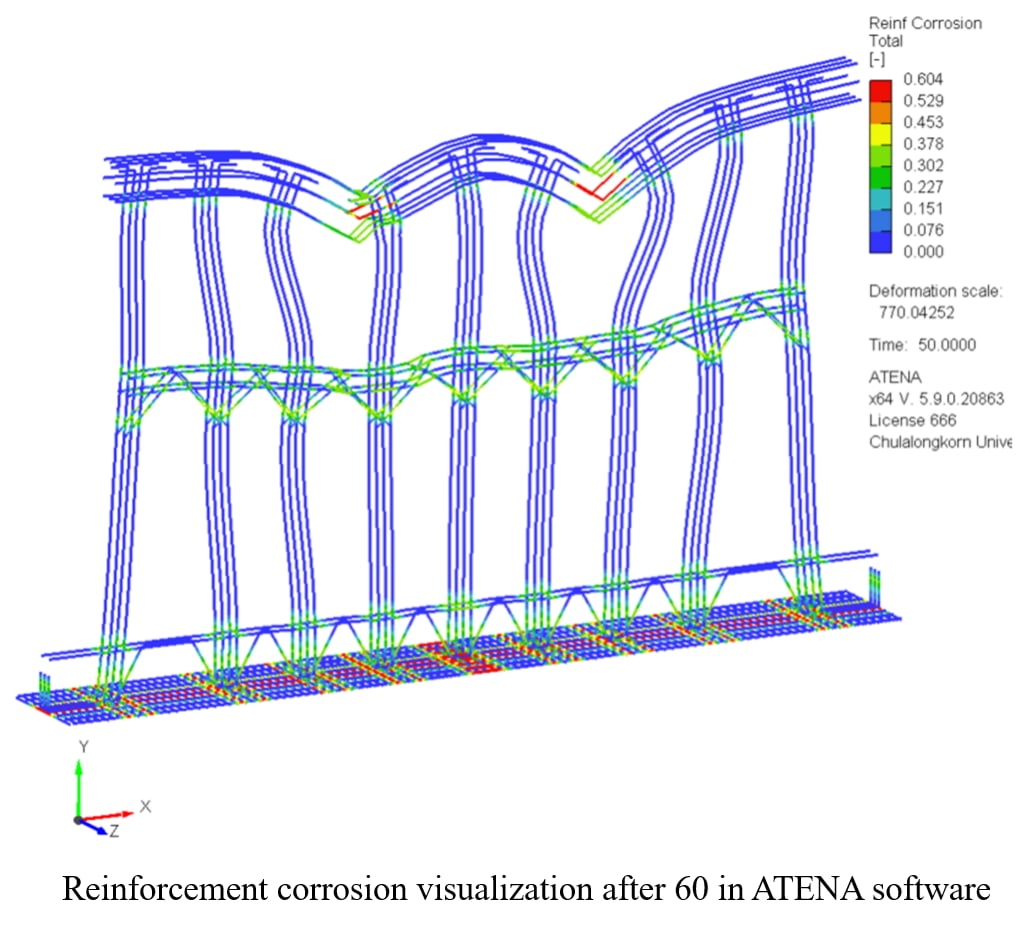
The results point to inspection and rehabilitation at 50 to 70 years of exposure, before the serviceability and safety limits are exceeded. The pier has the reinforcement detailing of the standard Department of Highways designs, so the same procedure applies to other bridges of this type.
Software
- GiD: 3D geometry and mesh
- ATENA Science: nonlinear analysis including chloride ingress, corrosion and cracking
- SARA Science: reliability index and probability of failure
This page summarises independent, peer-reviewed research by Waseda University, Chulalongkorn University and the Thailand Department of Highways. Červenka Consulting was not involved in the study; it is presented as an example of ATENA used in research and practice.