|
Dear ATENA Friends,
We are happy to share the latest news from the ATENA world!
In this issue, we highlight selected ATENA 2026 features, including practical ways to use Python scripting and parametric modelling for nonlinear analysis of concrete structures. An industrial floor made of fibre-reinforced concrete illustrates how these tools can support the exploration of design alternatives. |
|
We also introduce ATENA-C4A, which brings ATENA’s nonlinear concrete material model directly into ANSYS Mechanical.
Looking ahead, we offer a preview of the features planned for ATENA 2027.
We have also launched a new version of our website, with a refreshed design and easier access to information about ATENA, our services and upcoming events. Visit us at www.cervenkaconsulting.com. |
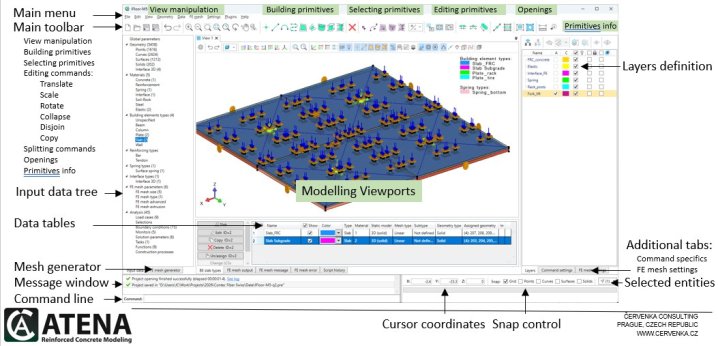
Fig. 1: View of the latest generation of ATENA Engineering native preprocessor showing the parametric definition of industrial floor.
|
|
Thank you to everyone who met with us at conferences, seminars and other events throughout this year and shared their engineering challenges and ideas. We look forward to continuing these conversations and meeting you again in the coming year.
With warm regards from Prague,
Your ATENA Team |
ATENA Development
|
ATENA 2026 was released this summer
ATENA 2026 brings more advanced analysis capabilities directly into the Engineering environment, together with tools for automating model preparation and exploring design alternatives.
Dynamic analysis in ATENA Engineering. Dynamic analyses can now be prepared directly in the Engineering preprocessor. This extends the familiar modelling workflow to applications such as seismic assessment, impact loading and vibration studies.
The figure on the right shows the seismic response of an 18-storey reinforced concrete building, calculated by a fully dynamic nonlinear implicit analysis. Such a demanding analysis can take up to two days on a standard workstation with 8 CPUs. |
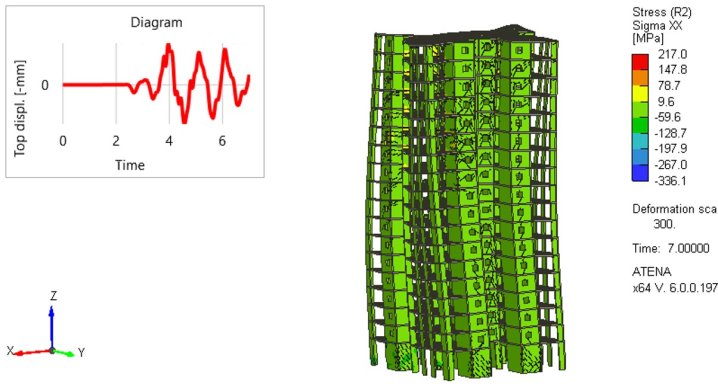
Fig. 2: Fully dynamic nonlinear implicit analysis of seismic response of 18 storey reinforced concrete building using Melendy Ranch accelerogram with peak ground acceleration 1.35g.
|
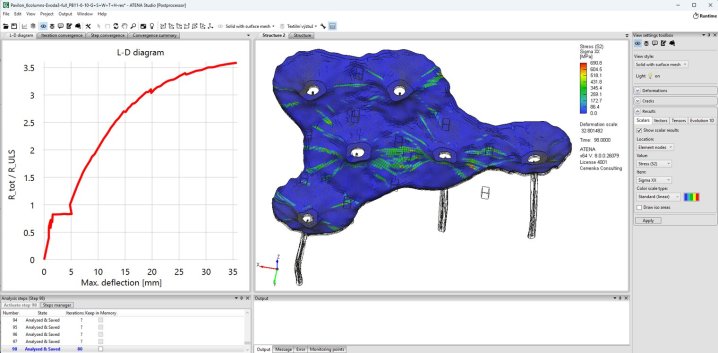
Fig. 3: Assessment of 3D printed structure pavilion in ATENA strengthened with carbon fiber textile reinforcement. Figure shows stresses in carbon fibres at load level 3.5xULS overloading.
|
3D concrete printing simulation directly from G-code. ATENA 2026 supports simulation of the printing process using the G-code files that control the printer. Engineers can use the printing sequence as the basis for numerical modelling and investigate its influence on the behaviour of the printed structure.
The figure on the left shows the assessment of a 3D printed pavilion strengthened with carbon fibre textile reinforcement. The model captures the stresses in the carbon fibres at a load level of 3.5 times the ULS load, giving insight into how the textile reinforcement carries load well beyond the design level. |
|
Python scripting for parametric modelling. Python scripts allow engineers to turn a model into a reusable, parameterised workflow. Instead of manually rebuilding each alternative, users can modify selected inputs and generate corresponding models with consistent assumptions.
The figure on the right shows the source Python script next to the parametric model it generates consisting of a selected section of a fibre-reinforced concrete industrial floor with four dilation sections, rack locations and fork-lift position. Because the geometry and inputs are defined in code, the same script can be rerun with different parameters to produce a new model in a consistent and traceable way. |
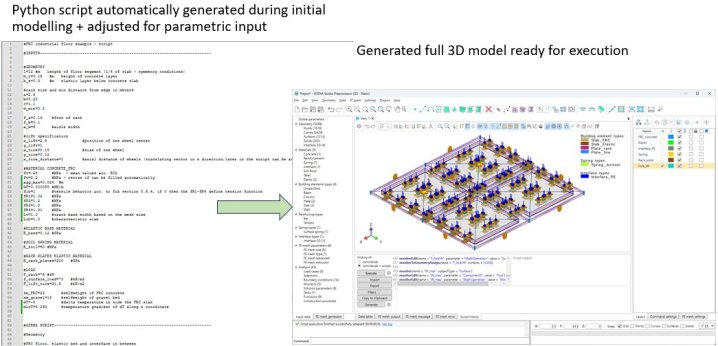
Fig. 4: Source Python script and the resulting parametric model of the analyzed section of a fiber-reinforced concrete industrial floor.
|
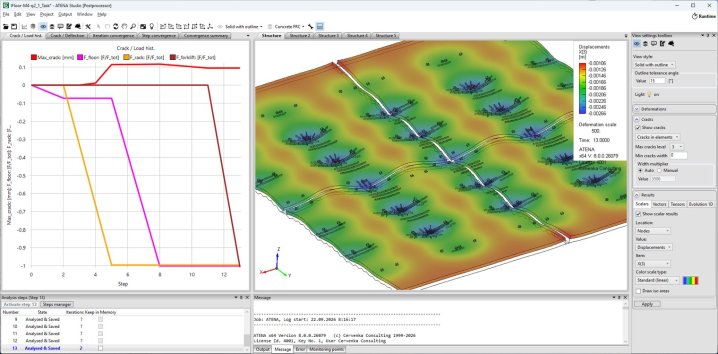
Fig. 5: Deformed shape, floor deflections and internal cracking in the last step of the floor assessment. Crack width remains below 0.07 mm.
|
In our industrial FRC floor example, the FRC material is defined according to the fib Model Code. The analysis considers rack-post and forklift-wheel loads, monitors crack widths and deflections during the calculation, and concludes with an automatically generated report.
Engineers can then compare alternative slab dimensions, thicknesses, material properties or load configurations and their influence on serviceability and load-bearing behaviour.
Watch our YouTube presentation on Python scripting and the FRC industrial floor example. |
|
Download ATENA 2026 and keep your maintenance active. The latest version is available for download to ATENA users with valid maintenance. Keep your maintenance agreement active to retain access to new versions, improvements and technical support. If your maintenance has expired, contact us to discuss renewal.
New users can also explore ATENA with a fully functional 30-day trial, requested directly through ATENA Center after installation. |
ATENA-C4A: Advanced Concrete Modelling in ANSYS
Jointly developed by DESIGNTEC and Červenka Consulting, ATENA-C4A brings ATENA’s nonlinear concrete material model directly into ANSYS Mechanical.
It captures concrete cracking and crushing, crack closure and reinforcement yielding in static and transient dynamic analyses, including cyclic loading. Engineers can evaluate crack widths, crack orientation and reinforcement strains within their familiar ANSYS environment.
Visit the ATENA-C4A website or request a free 30-day trial. An annual ATENA-C4A subscription and a separate ANSYS licence are required. |
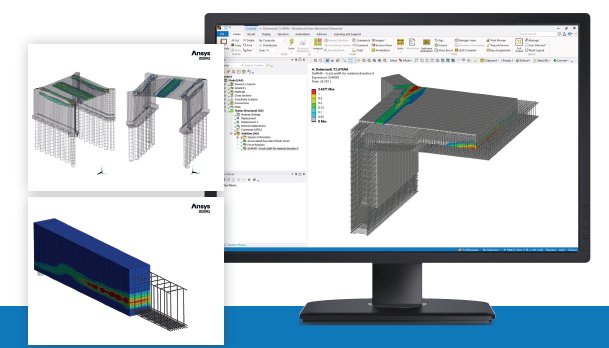
Fig. 6: ATENA concrete model results in the ANSYS environment.
|
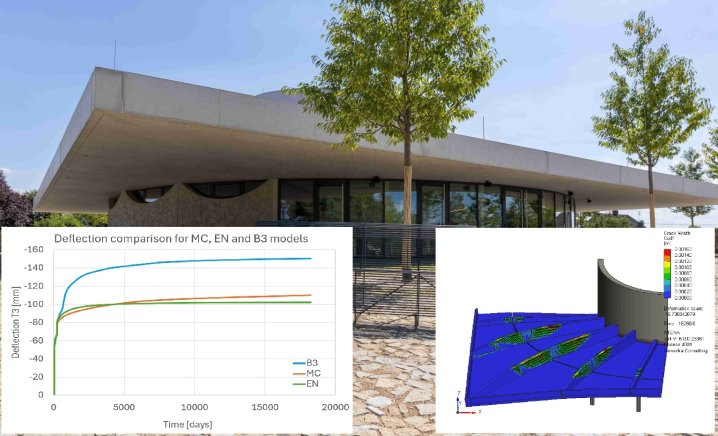
Fig. 7: Example of long term deflection verification of a large cantilevered slab in ATENA software considering various creep & shrinkage models.
|
Looking Ahead to ATENA 2027
The ATENA 2027 public beta is expected in November 2026, with the final release planned for February 2027. The forthcoming version is being developed around three main additions:
Creep and shrinkage modelling in ATENA Engineering. Long-term analysis capabilities previously available only in ATENA Science are coming to the Engineering environment, allowing users to include creep and shrinkage within the same interface used to prepare their other analyses.
The figure on the left shows the long-term deflection verification of a large cantilevered slab, comparing the predictions of the fib Model Code, Eurocode and B3 creep and shrinkage models over time. |
|
Guided task and loading-history setup. New wizards will guide users through task definition and the setup of analysis loading histories for common applications. These include ultimate limit state (ULS) verification, serviceability limit state (SLS) verification, simulation of experiments and cyclic loading. The aim is to make the selection and configuration of an appropriate analysis procedure easier and more consistent.
The figure on the right shows the wizard set up for an ultimate limit state verification. The user assigns the relevant load cases, such as self-weight, permanent and live loads, and the wizard prepares the corresponding loading history. This reduces manual setup and helps ensure that comparable analyses are configured in the same way. |
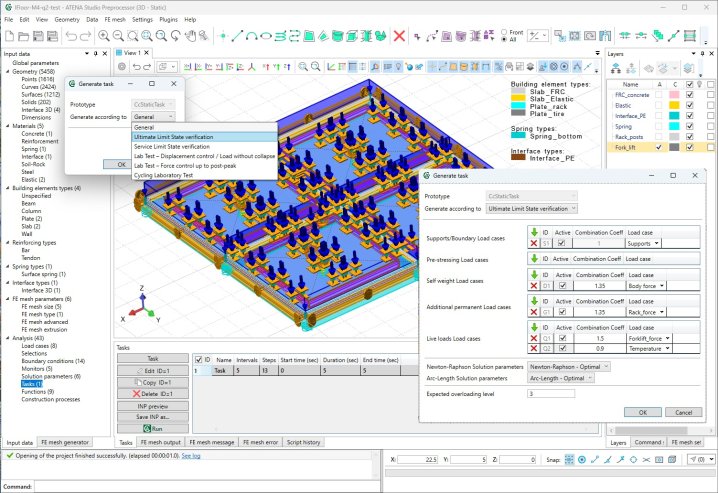
Fig. 8: New task wizard for guiding users in typical simulation scenarios.
|
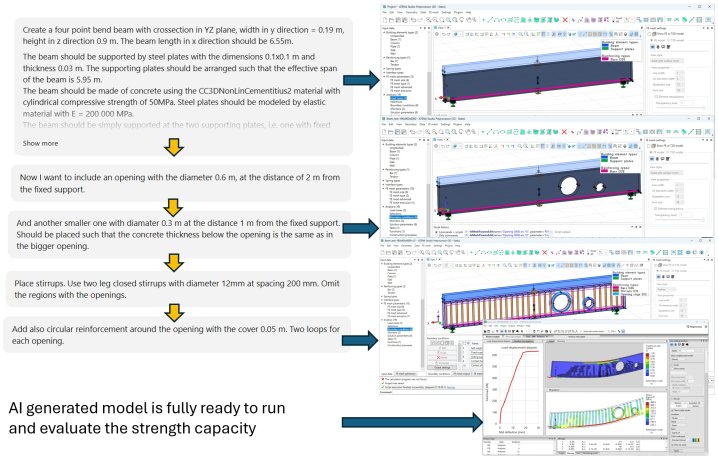
Fig. 9: Example of building a beam with opening and stirrups using AI agent.
|
Connecting ATENA to AI agents through MCP. ATENA 2027 will enable the ATENA Preprocessor to act as a Model Context Protocol (MCP) server, connecting it to compatible AI agents or applications. This interface will provide a foundation for AI-assisted interaction with ATENA modelling workflows, while engineers remain responsible for modelling assumptions and the interpretation of results.
The figure on the left shows a model built step by step from plain-language instructions: a four-point bending beam, followed by two circular openings, stirrups that omit the opening regions, and reinforcement loops around each opening.
We look forward to sharing the public beta and hearing your feedback as we prepare the final release. |
Success Stories
Tracking the Effects of Corrosion on Bridge Pier Reliability
An independent study by researchers from Chulalongkorn University, Waseda University and Thailand’s Department of Highways assessed how chloride-induced corrosion reduces the reliability of an in-service structure: Pier No. 5 of the Chanthaburi River Bridge in eastern Thailand, exposed to tidal splash and airborne chlorides from the Gulf of Thailand.
The pier was modelled in 3D in GiD and analysed in ATENA Science, after the model had been verified against full-scale test data from the Nougawa Bridge in Japan. Chloride ingress and progressive reinforcement corrosion were simulated over a 90-year service life in 10-year steps, and SARA Science was used at each stage to calculate the reliability index and probability of failure. |
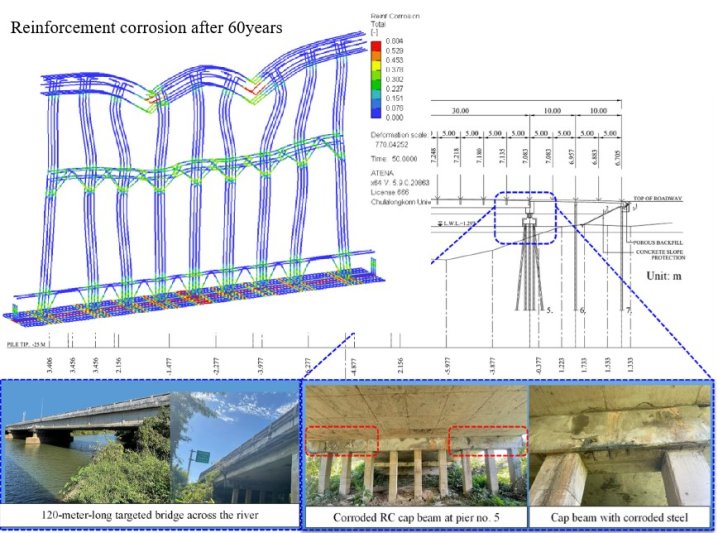
Fig. 10: Photo of the deteriorated bridge and ATENA modelling of the reinforcement corrosion after 60 years.
|
|
Over 90 years, the reliability index fell from 5.84 to 4.73, dropping below the Eurocode Class 3 target (β = 5.2) after roughly 60–70 years. Ultimate load capacity decreased by 11% and reinforcement cross-section loss reached 79%. The results point to a maintenance window at around 50–70 years of chloride exposure, showing how nonlinear analysis combined with probabilistic assessment can support maintenance planning for existing bridges.
Read the original open-access paper. |
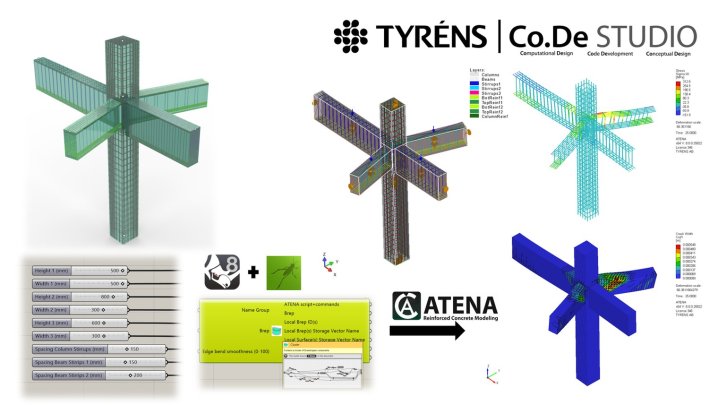
Fig. 11: Workflow of parametric modelling utilizing Rhino 3D + Grasshopper + ATENA.
|
From Parametric Design to Nonlinear Analysis at Tyréns in Sweden
At Swedish engineering consultancy Tyréns, engineers David Andersson and Mikael Hallgren use ATENA to assess complex reinforced concrete connections.
Multi-directional column–beam joints are developed parametrically in Rhino3D and Grasshopper, then analysed in ATENA to investigate stress concentrations, crack development and the interaction between concrete and reinforcement. This helps them understand the response of demanding connection details before construction. |
Assessing GFRP Strengthening of Seismically Vulnerable Bridge Piers
An independent study by researchers from Chulalongkorn University, Mahidol University, Thailand’s Department of Highways and Shenzhen University investigated glass fibre-reinforced polymer (GFRP) strengthening of short-span bridge piers.
The team combined cyclic loading tests with detailed ATENA nonlinear models, comparing calculated response and crack patterns with experimental observations. Repaired and strengthened specimens achieved approximately 22–24% higher peak lateral resistance, with ductility improvements of up to 34.6%. |
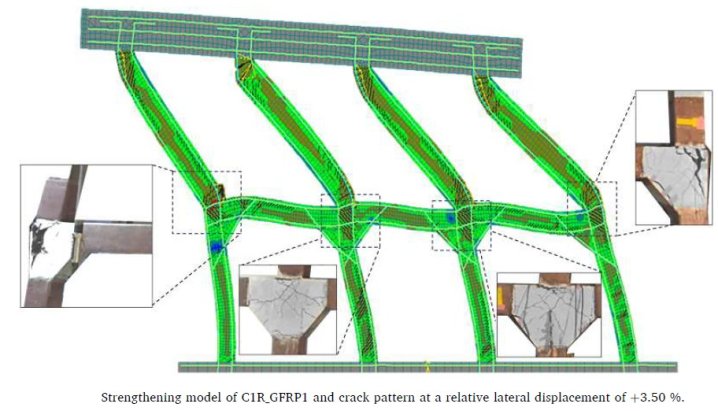
Fig. 12: ATENA deformed shape and crack pattern of the strengthened model.
|
|
ATENA provided the detailed experimental validation; subsequent regional pushover and fragility assessments across 24 pier configurations were performed in SAP2000. The study demonstrates how testing and numerical modelling can work together to evaluate strengthening strategies and support retrofit prioritisation.
Read the original open-access paper.
The three presented research and development studies above were conducted independently; Červenka Consulting was not involved in the research and development. |
Upcoming ATENA Webinars
|
Alongside the upcoming ATENA 2027 release, we are preparing a series of webinars. Planned topics include:
Introduction and Overview of ATENA 2027. Get a first look at what ATENA 2027 brings: creep and shrinkage analysis, an automated wizard for task definition, an MCP server connecting ATENA to AI agents, and a range of new geometric modelling features. A good starting point for planning how the new version fits into your work.
AI Capabilities in ATENA. Take a closer look at the MCP functionality in the ATENA preprocessor. See how an AI agent can take a task described by voice or text and turn it into a model or an analysis report.
Modelling Long-Term Behaviour of Reinforced Concrete Structures in ATENA. Follow the complete workflow, from model definition through analysis to post-processing, for structures where long-term deformation and shrinkage must be taken into account.
The exact dates and times will be announced on our website. Is there a topic you would like us to cover? Reply to this newsletter and let us know. You can find previous ATENA webinars on our YouTube channel. |
Where You Can Meet Us
|
Our planned conference participation for 2026–2027 includes the following events.
31. Betonářské dny 2026, 26–27 November 2026, Litomyšl, Czech Republic. Official website
36th Dresdner Brückenbausymposium, 10–11 March 2027, Dresden, Germany. Official website
ACI Concrete Convention – Spring 2027, 21–24 March 2027, Las Vegas, USA. Official website
32nd International Symposium MOSTY 2027, 22–23 April 2027, Brno, Czech Republic. Official website
WEIK – Wind Engineering Institute of Korea, 28–29 May 2027, South Korea. WEIK website
fib Symposium 2027, 7–9 June 2027, Dresden, Germany. Official website |
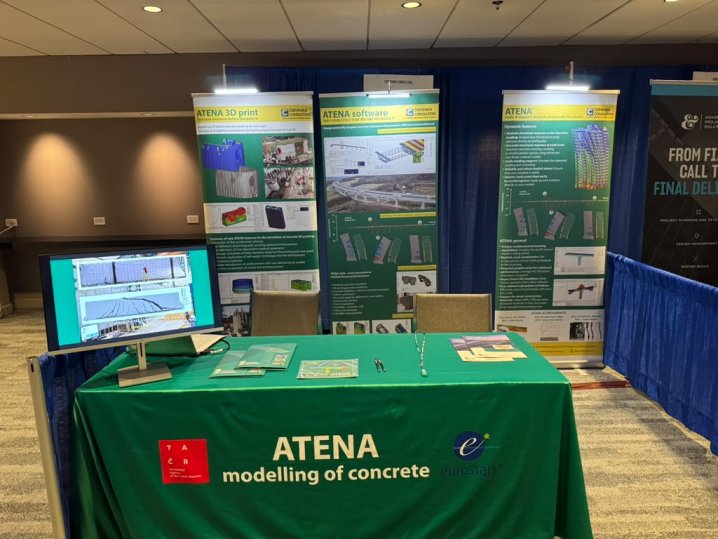
Fig. 13: Come to see us at ATENA conference stand.
|
|
fib CACRCS 2027, 28–30 June 2027, Barcelona, Spain. Official website
ESMC 2027 / CFRAC 2027, 5–9 July 2027, Louvain-la-Neuve, Belgium. Official website
SMiRT29, 8–13 August 2027, Lyon, France. Official website |
Recent ATENA Articles
|
CERVENKA J., RYMES J., AHMAD M., Efficient macro-scale models for reinforcement corrosion modelling in reinforced concrete structures, KCI Spring 2026 Conference of the Korea Concrete Institute, 6 - 8 May 2026, Proceedings of the 2026 Spring Conference of the Korea Concrete Institute, Vol. 38, No. 1 (Issue No. 74)
CERVENKA J., JENDELE L., RYMES J., HERZFELDT M., Numerical modelling and transient simulation of digital concrete, KCI Spring 2026 Korea Concrete Institute, 6 - 8 May 2026, Proceedings of the 2026 Spring Conference of the Korea Concrete Institute, Vol. 38, No. 1 (Issue No. 74)
KOVAR J., CERVENKA J., CERVENKA V., NOVAK L., LEHKY D., NOVAK D., FE modelling supported by AI-driven framework for reinforced concrete simulation, 17th World Congress on Computational Mechanics (WCCM) 10th European Congress on Computational Methods in Applied Sciences and Engineering (ECCOMAS) 19 - 24 July 2026, Munich, Germany
SOVADINA, M., HRDLIČKOVÁ, K., HALODOVÁ, P., HERZFELDT, M., KOVÁŘ, J., ČERVENKA, J., FRANTOVÁ, M., KHMUROVSKA, J., ŠTEMBERK, P., ŽÁK, J. Effects of neutron flux on concrete shielding structures: From Constituent Materials to Structural Performance, Fontevraud 11 - International Symposium on Contribution of Materials Investigations and Operating Experience to LWRs’ Safety, Performance and Reliability, September 14 - 16, 2026, Avignon, France
CERVENKA J., KOVAR J., Blind prediction of steel fiber-reinforced slab punching resistance based on lessons learned from previous contests - FRC2026 Budapest: Fibre Reinforced Concrete ‒ from Design to Structural Applications Joint ACI-fib-RILEM International Workshop, September 28 to 30, 2026
CERVENKA, J., CERVENKA, V., SKADINS, U., Beyond the Safety Factor: Confronting Uncertainty in Nonlinear Reinforced Concrete Analysis, 15th Central European Congress on Concrete Engineering, Vodice, Croatia, Oct 5-7, 2026 |
Let us Discuss Your Application
|
Thank you for reading. Whether you are planning a new project, evaluating ATENA for your organisation or need support with a specific analysis, our team is happy to help. Send us your questions through our request information form and we will get back to you.
With best regards from Prague,
Your ATENA Team |
|


